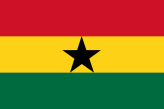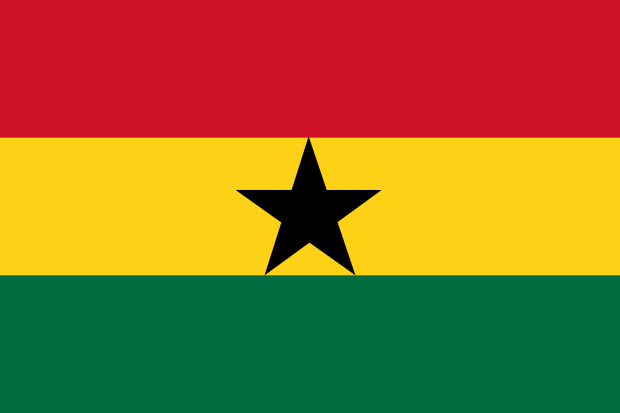
Ghana

Country flag available in this resolutions
| Icon 32x21 | ![]() |
| Icon 88x59 | ![]() |
Ghana
Ghana, often referred to as West Africa’s „Gateway to Africa“, stands as a vibrant and historically significant nation on the continent’s western coast. Its name, derived from the ancient Ghana Empire, though geographically distinct, evokes a rich heritage of trade and powerful kingdoms. Situated along the Gulf of Guinea, Ghana shares its borders with Côte d’Ivoire to the west, Burkina Faso to the north, and Togo to the east, occupying a strategic position that has shaped its past and continues to influence its present. The country’s diverse landscape ranges from low-lying coastal plains, characterized by sandy beaches and lagoons, to a central plateau dissected by the Volta River basin, home to Lake Volta – one of the world’s largest artificial lakes. Further inland, the terrain gives way to the Akwapim-Togo ranges and the drier savanna of the north. Ghana’s tropical climate features two rainy seasons in the south and one in the north, supporting its rich biodiversity and agricultural productivity. This geographical bounty is complemented by substantial natural resources, including abundant gold, industrial diamonds, bauxite, manganese, timber, and more recently, significant offshore petroleum and natural gas reserves, making it a key player in the regional economy.
The history of Ghana is a compelling narrative of powerful indigenous kingdoms, the devastating impact of the transatlantic slave trade, and a pioneering struggle for independence. Before European arrival, the region was home to several sophisticated states, most notably the Ashanti Empire, which flourished from the 17th to the late 19th century, controlling vast territories and a lucrative gold trade. Other significant groups included the Fante, Ga-Adangbe, Ewe, and Mole-Dagbon. European powers, initially the Portuguese, established trading posts along the coast from the 15th century, primarily for gold, which led to the region being known as the „Gold Coast“. This era soon transitioned into the horrific slave trade, with numerous European forts and castles, like Elmina and Cape Coast, serving as grim reminders of this dark period. By the late 19th century, the British had consolidated their control, defeating the Ashanti in a series of wars and establishing the Gold Coast Colony. The 20th century witnessed a burgeoning nationalist movement, spearheaded by figures like Kwame Nkrumah. Nkrumah’s Convention People’s Party (CPP) successfully mobilized the populace, leading Ghana to become the first sub-Saharan African nation to gain independence from colonial rule on March 6, 1957. Nkrumah envisioned a united and prosperous Africa, advocating for Pan-Africanism, but his rule eventually grew autocratic, leading to his overthrow in 1966. The subsequent decades were marked by a series of military coups and political instability until the late 1980s, when Jerry Rawlings, who had come to power through a coup, transitioned the country towards a multi-party democracy. Since the early 1990s, Ghana has maintained a stable democratic system, with peaceful transfers of power between ruling parties, earning it a reputation as a beacon of democracy in West Africa.
Ghana’s demography reflects its rich tapestry of cultures and traditions. With a population estimated at over 33 million, it is a diverse nation comprising numerous ethnic groups. The Akan, including the Ashanti, Fante, Akyem, and Kwahu, constitute the largest group, predominantly found in the central and southern regions. Other major ethnic groups include the Ewe in the east, the Ga-Adangbe around Accra, and various Mole-Dagbon peoples, such as the Dagomba and Mamprusi, in the north. English serves as the official language, a legacy of British colonialism, and is widely used in government, education, and business. However, a multitude of indigenous languages thrive, with Akan (particularly its Twi and Fante dialects) being the most widely spoken, followed by Ewe, Ga, and Dagbani. Christianity is the dominant religion, practiced by a majority of the population, followed by Islam, which has a significant presence, especially in the northern regions. Traditional African religions also continue to be practiced, often alongside Christianity or Islam, reflecting a deep spiritual heritage. Ghana has experienced significant urbanization, with major cities like Accra, Kumasi, and Tamale growing rapidly, attracting people from rural areas in search of economic opportunities. The country has made considerable strides in education and healthcare, boasting relatively high literacy rates and a commitment to universal primary education, which bodes well for its future human capital development.
The Ghanaian economy has undergone significant transformation in recent decades, transitioning from a low-income agricultural economy to a lower-middle-income country driven by services, natural resources, and a growing industrial base. Agriculture remains a vital sector, employing a substantial portion of the workforce, with cocoa being the most prominent export crop. Ghana is the world’s second-largest producer of cocoa, a commodity that has historically been the backbone of its economy. Other important agricultural products include yam, cassava, maize, plantain, and timber. The mining sector is another cornerstone, with Ghana being one of Africa’s leading gold producers, alongside significant output of industrial diamonds, bauxite, and manganese. A major turning point came in 2010 with the commencement of commercial oil production from the Jubilee field, which has added a new dimension to the economy, contributing substantially to government revenue and attracting foreign direct investment. The services sector, encompassing finance, tourism, and telecommunications, has also expanded rapidly, becoming the largest contributor to the country’s Gross Domestic Product (GDP). Despite this progress, Ghana faces economic challenges, including managing inflation, reducing public debt, and diversifying its economy further to reduce reliance on commodity exports, which are susceptible to global price fluctuations. Nevertheless, its stable political environment, strategic location, and a relatively well-educated workforce position Ghana as an attractive destination for investors and a potential economic hub in West Africa.
Culturally, Ghana is a nation of profound artistic expression and strong communal bonds. Its rich heritage is showcased through various art forms, including the vibrant Kente cloth, with its intricate patterns and symbolic meanings, and the Adinkra symbols, which convey traditional wisdom and proverbs. Ghanaian music is diverse and dynamic, from the traditional Highlife genre, which blends local rhythms with Western influences, to contemporary Afrobeats and Azonto. Dance is an integral part of celebrations and rituals, reflecting the diversity of its ethnic groups. Ghanaian cuisine is flavorful and hearty, with staples like Banku, Fufu, Kenkey, and Jollof rice being popular dishes enjoyed across the country. Hospitality is a deeply ingrained cultural value, and Ghanaians are renowned for their warmth and welcoming nature towards visitors. The country’s commitment to democracy and good governance, coupled with its economic potential and rich cultural heritage, positions Ghana as a fascinating and important nation on the African continent, striving towards sustainable development and a prosperous future for its people.
Information about country Ghana
Automated text translation, excuse errors, please!
Informations are from the publication CIA The World Factbook.
Country Ghana is situated in a location / continent Africa. Ghana has an area of 238 533 km2 and 24 652 402 residents. The highest point has a height 880 above sea level. and it is called Mount Afadjato. The lowest point is located at the level of 0 above sea level and it is named Atlantic Ocean. System of government is republic and the date of independence 6th March 1957. The capital city is Accra. Ghana has the international abbreviation GH.
Ghana - economy
Total gross domestic product (GDP) is 75 900 000 000 $. Total gross domestic product per capita in purchasing power parity is 3 100 $. GDP grows by 13.60 % a year. Inflation (consumer price index) is equal to 8.70 % a year. Ghana have 11 440 000 working-age population (from a total population 24 652 402 people). Unemployment is at 11.00 %. Ghana issued 10.60 % GDP to healt care and 1,70 % GDP to army. The public debt of the country is 36.20 % GDP. The total amount of foreign debt is 7 511 000 000 USD.
Ghana - transport and telecommunications
Ghana has 62 221 km of roads, 947 km of railway lines and 10 airports. The total length of waterways (navigable rivers, canals, etc.) is 1 293 km. There is registered 4 ships.
Number of active mobile phones (sim card) in the country Ghana is 21 166 000. Number of active fixed telephone lines is 284 700. Ghana has 1 297 000 internet users, who have the available 60 282 Internet connections. Ghana has been assigned a domain first Choose range .gh.
Ghana - demography
As suggested above, Ghana has 24 652 402 people. Population growth is in the amount 1.79 % per year. Number of children born per 1000 population per year is 26.99.Every mother has average 4.15 children. The infant mortality rate is 47.26 and maternal mortality 350.00 deaths per 100,000 births. Average estimated life expectancy makes 61.45 years. Mortality is 8.57 people per 1000 population per year.
Ghana - energetics
Ghana consumes a year 6 122 000 000 kWh of electricity. Annual electricity production is 8 764 000 000 kWh in power plants with a total installed electrical capacity 1 985 000 kW. Ghana exports 752 000 000 kWh and imports 198 000 000 kWh of electricity per year Energy mix of power generation is as follows: fossil fuels: 40.6 %, nuclear energy: 0 %, renewable: 0.0 %, hydropower: 59.4 %. The country Ghana is harvested annually 72 580 barrels of oil.
Flags of the world countries
World flags
World countries flags
Dále doporučujeme:
Tipy na užitečné webyNaše tipy na užitečné weby
Odkazy nejen na naše partnerské weby
Zajímavé webové stránky
Doporučené odkazy a zdroje obsahu
![]() |
![]() |
![]() |
![]() |
![]() |
![]() |
![]() |
![]() |
![]() |
![]() |
![]() |
![]() |
![]() |
![]() |
![]() |
![]() |
![]() |
![]() |
![]() |