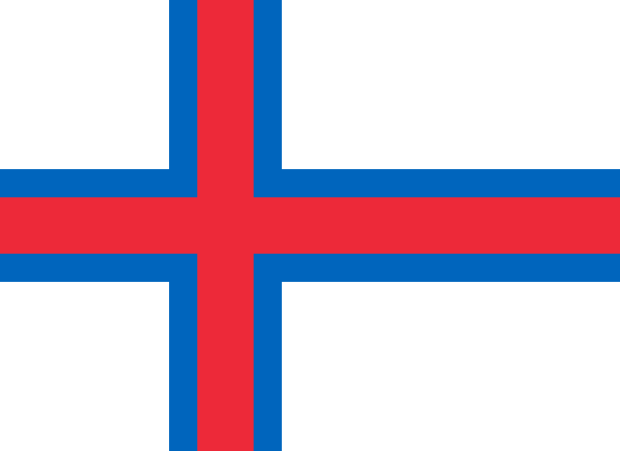
Faroe Islands

Country flag available in this resolutions
| Icon 32x23 | ![]() |
| Icon 88x64 | ![]() |
Faroe Islands
The Faroe Islands, an enigmatic archipelago nestled in the wild expanse of the North Atlantic Ocean, present a captivating blend of rugged natural beauty, profound cultural heritage, and a resilient, self-reliant spirit. Situated roughly equidistant between Scotland, Norway, and Iceland, these eighteen rocky islands, seventeen of which are inhabited, stand as a testament to human adaptation and perseverance in a challenging, yet breathtakingly beautiful, environment. Their unique status as an autonomous territory within the Kingdom of Denmark affords them a distinct political identity, further solidifying their independent cultural trajectory.
The Geography of the Faroe Islands is defined by its dramatic volcanic origins, resulting in a landscape dominated by steep cliffs, deep fjords, and verdant, treeless hills. The islands’ highest point, Slttaratindur, reaches 880 metres, offering panoramic views of the surrounding ocean and neighbouring islands. Despite their northern latitude, the climate is subpolar oceanic, moderated by the Gulf Stream, leading to cool summers and mild winters, though often accompanied by strong winds, fog, and frequent rain. The lack of native trees is a striking feature, with the landscape primarily covered by grass, moss, and hardy shrubs, supporting a rich birdlife, most notably puffins and gannets, which nest on the towering sea cliffs. The isolation has also fostered unique flora and fauna, making the islands a haven for nature enthusiasts seeking unspoiled wilderness.
The History of the Faroe Islands stretches back to the early medieval period, with evidence suggesting Irish monks may have been the first settlers around the 6th century. However, it was the Norse Vikings who established permanent settlements in the 9th century, profoundly shaping the islands’ language, culture, and social structure. The Faroes came under Norwegian rule in the 11th century, and subsequently, with the Kalmar Union, fell under Danish-Norwegian control. When Norway was ceded to Sweden in 1814, the Faroes remained with Denmark, becoming a Danish county. A pivotal moment arrived during World War II when, with Denmark occupied by Germany, the Faroe Islands were occupied by British forces, leading to a period of increased self-sufficiency and a stronger sense of national identity. This ultimately culminated in the granting of Home Rule in 1948, establishing the islands as a self-governing nation within the Danish Realm, with their own parliament (Lgting) and flag.
In terms of Demography, the Faroe Islands are home to a small, close-knit population of approximately 54,000 people. The vast majority are ethnic Faroese, descendants of the Norse settlers, speaking Faroese, a distinct North Germanic language closely related to Icelandic and Old Norse. This linguistic heritage is a cornerstone of Faroese identity, carefully preserved and taught in schools. The population is largely distributed across numerous small towns and villages, with the capital, Tórshavn, being the largest urban centre. While the population has seen fluctuations due to emigration and immigration, especially among younger generations seeking education or work abroad, a strong sense of community and connection to the homeland often draws people back. Lutheranism is the predominant religion, reflecting historical ties to Scandinavia.
The Economy of the Faroe Islands has historically been, and remains, heavily reliant on the sea. Fishing and aquaculture are the absolute backbone, accounting for a significant portion of the islands’ GDP and export revenue. Salmon farming, particularly, has seen substantial growth and is a major export commodity alongside wild-caught fish like cod, haddock, and herring. Shipping also plays a vital role, connecting the islands to the rest of the world and supporting their maritime industries. In recent decades, tourism has emerged as a rapidly growing sector, attracting visitors with the islands’ stunning landscapes, unique culture, and opportunities for hiking, birdwatching, and experiencing the tranquil island life. While there is some limited sheep farming and small-scale agriculture, the rugged terrain and climate limit its potential. Exploration for oil and gas in Faroese waters represents a potential future economic avenue, though its development is approached with caution and environmental consideration.
Faroese Culture and Society are deeply rooted in their isolation and maritime history. The Faroese language is not merely a means of communication but a profound symbol of national identity, meticulously nurtured and celebrated. Traditional music, including the unique Faroese chain dance (kvi), which tells ancient sagas through song and movement, is an integral part of cultural life. Craftsmanship, particularly involving wool, is also prominent, reflecting the islands’ long history of sheep farming. The grindadráp, the traditional pilot whale hunt, remains a deeply ingrained cultural practice for food, though it is often subject to international scrutiny and debate. Education is highly valued, with the islands boasting a modern welfare system that provides comprehensive healthcare and social services. The strong sense of community, mutual support, and a profound connection to nature are defining characteristics of Faroese society.
Politically, the Faroe Islands navigate a complex and evolving relationship with Denmark. As a self-governing nation within the Danish Realm, they exercise extensive autonomy over most domestic affairs, including education, healthcare, social services, and industry, while Denmark retains responsibility for defence, foreign policy, and justice. The Faroes maintain their own flag, issue their own currency (the Faroese króna, pegged to the Danish krone), and have their own representatives in the Danish Parliament. There is an ongoing and vibrant political debate within the islands regarding the extent of their autonomy, with a significant segment of the population advocating for full independence from Denmark, driven by a desire for complete self-determination and the ability to forge their own path on the international stage. This aspiration for greater sovereignty reflects a strong and enduring national pride.
In conclusion, the Faroe Islands are far more than just a cluster of remote North Atlantic rocks; they are a vibrant, self-aware nation with a rich heritage, a distinctive language, and a robust culture. From their dramatic, windswept landscapes and a history shaped by Vikings and the sea, to a modern economy thriving on fishing and a burgeoning tourism sector, the islands present a compelling narrative of resilience. Their unique political status and the ongoing quest for greater self-determination underscore a profound sense of identity and a forward-looking spirit, ensuring that these captivating islands will continue to carve their own remarkable destiny in the heart of the ocean.
Information about country Faroe Islands
Automated text translation, excuse errors, please!
Informations are from the publication CIA The World Factbook.
Country Faroe Islands is situated in a location / continent Europe. Faroe Islands has an area of 1 393 km2 and 49 483 residents. The highest point has a height 882 above sea level. and it is called Slaettaratindur. The lowest point is located at the level of 0 above sea level and it is named Atlantic Ocean. The capital city is Torshavn. Faroe Islands has the international abbreviation FO.
Faroe Islands - economy
Total gross domestic product (GDP) is 1 471 000 000 $. Total gross domestic product per capita in purchasing power parity is 30 500 $. GDP grows by 2.90 % a year. Inflation (consumer price index) is equal to 2.30 % a year. Faroe Islands have 34 710 working-age population (from a total population 49 483 people). Unemployment is at 6.80 %. The total amount of foreign debt is 888 800 000 USD.
Faroe Islands - transport and telecommunications
Faroe Islands has 463 km of roads and 1 airports. There is registered 37 ships.
Number of active mobile phones (sim card) in the country Faroe Islands is 59 400. Number of active fixed telephone lines is 20 200. Faroe Islands has 37 500 internet users, who have the available 7 595 Internet connections. Faroe Islands has been assigned a domain first Choose range .fo.
Faroe Islands - demography
As suggested above, Faroe Islands has 49 483 people. Population growth is in the amount 0.45 % per year. Number of children born per 1000 population per year is 13.14.Every mother has average 2.40 children. The infant mortality rate is 5.94 .Average estimated life expectancy makes 79.85 years. Mortality is 8.67 people per 1000 population per year.
Faroe Islands - energetics
Faroe Islands consumes a year 268 800 000 kWh of electricity. Annual electricity production is 280 300 000 kWh in power plants with a total installed electrical capacity 100 100 kW. Faroe Islands exports 0 kWh and imports 0 kWh of electricity per year Energy mix of power generation is as follows: fossil fuels: 64.9 %, nuclear energy: 0 %, renewable: 4.1 %, hydropower: 31.0 %.
Flags of the world countries
World flags
World countries flags
Dále doporučujeme:
Linky na partnerské webyTipy na užitečné weby
Odkazy na užitečné webové stránky
Doporučené internetové odkazy
Zajímavé internetové odkazy
![]() |
![]() |
![]() |
![]() |
![]() |
![]() |
![]() |
![]() |
![]() |
![]() |
![]() |
![]() |
![]() |
![]() |
![]() |
![]() |
![]() |
![]() |
![]() |