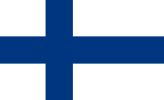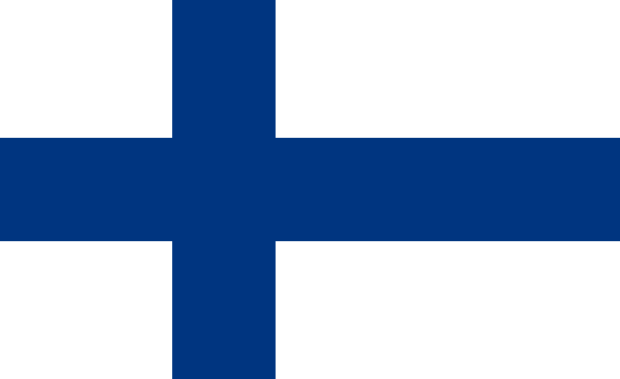
Finland

Country flag available in this resolutions
| Icon 32x20 | ![]() |
| Icon 88x54 | ![]() |
Finland
Finland, or Suomi as it’s known natively, is a captivating Nordic nation situated in Northern Europe. Bordered by Sweden to the west, Norway to the north, and Russia to the east, it’s a land defined by its extraordinary natural beauty and stark contrasts. Geographically, Finland is often called the „Land of a Thousand Lakes,“ with nearly 188,000 bodies of water. These vast freshwater bodies, coupled with extensive dense forests – covering approximately 75% of its land area – create a pristine, almost untouched wilderness. The landscape is predominantly flat, with gentle hills, a legacy of the last ice age which also sculpted its countless archipelagos along the Baltic Sea coast. Its climate is characterized by cold, snowy winters and relatively mild summers, with the northern parts experiencing the magical phenomenon of the Midnight Sun in summer and the ethereal Aurora Borealis in winter. This unique environment has profoundly shaped Finnish culture and its people’s deep connection to nature.
Finland’s history is a testament to resilience and adaptation, marked by centuries of foreign rule before achieving its hard-won independence. For over 600 years, from the 12th century until 1809, Finland was an integral part of the Kingdom of Sweden, during which time Swedish law, administration, and language significantly influenced Finnish society. Following the Finnish War, it became an autonomous Grand Duchy within the Russian Empire, maintaining some of its Swedish-era laws and developing a distinct national identity under Russian suzerainty. This period, particularly in the late 19th and early 20th centuries, saw the rise of a strong Finnish nationalist movement, culminating in its declaration of independence on December 6, 1917, amidst the turmoil of the Russian Revolution. The early years of independence were fraught with challenges, including a brutal civil war in 1918 and the Winter War (1939–1940) and Continuation War (1941–1944) against the Soviet Union. Despite immense territorial losses, Finland preserved its sovereignty, a remarkable feat solidifying its national spirit of „sisu“ – a unique Finnish concept signifying extraordinary determination and perseverance. Post-war, Finland successfully navigated a delicate geopolitical position, maintaining neutrality while fostering strong ties with both East and West, eventually joining the European Union in 1995.
Today, Finland is home to a relatively small population of approximately 5.6 million people, predominantly ethnic Finns. The country is officially bilingual, with Finnish and Swedish holding equal status, a legacy of centuries of Swedish rule. A small indigenous Sámi population resides in the northern Lapland region, preserving their unique culture and language. Finland is renowned for its high quality of life, robust welfare state, and progressive social policies. The Finnish education system consistently ranks among the best globally, emphasizing equity, teacher professionalism, and personalized learning. Economically, Finland transformed from an agrarian and forestry-dependent nation into a highly industrialized, technologically advanced economy, with key sectors including electronics, machinery, forestry products, and information technology, famously exemplified by Nokia’s former dominance. The country invests heavily in research and development, fostering innovation and a strong startup ecosystem. Finland consistently ranks high in global indices for innovation, competitiveness, and human development. It champions gender equality, reflected in its political landscape and workforce participation. Finnish society values honesty, punctuality, and a strong sense of community, often expressed through the tradition of sauna, a ritual deeply embedded in the national psyche for physical and mental cleansing and social bonding. This blend of natural beauty, historical resilience, and modern innovation makes Finland a truly unique and admirable country on the global stage.
Information about country Finland
Automated text translation, excuse errors, please!
Informations are from the publication CIA The World Factbook.
Country Finland is situated in a location / continent Europe. Finland has an area of 338 145 km2 and 5 262 930 residents. The highest point has a height 1 328 above sea level. and it is called Haltiatunturi. The lowest point is located at the level of 0 above sea level and it is named Baltic Sea. System of government is republic and the date of independence 6th December 1917. The capital city is Helsinki. Finland has the international abbreviation FI.
Finland - economy
Total gross domestic product (GDP) is 198 200 000 000 $. Total gross domestic product per capita in purchasing power parity is 36 700 $. GDP grows by 2.90 % a year. Inflation (consumer price index) is equal to 3.30 % a year. Finland have 2 682 000 working-age population (from a total population 5 262 930 people). Unemployment is at 7.80 %. Finland issued 11.70 % GDP to healt care and 2,00 % GDP to army. The public debt of the country is 48.60 % GDP. The total amount of foreign debt is 577 000 000 000 USD.
Finland - transport and telecommunications
Finland has 78 141 km of roads, 5 919 km of railway lines and 148 airports. The total length of waterways (navigable rivers, canals, etc.) is 7 842 km. There is registered 97 ships.
Number of active mobile phones (sim card) in the country Finland is 8 390 000. Number of active fixed telephone lines is 1 250 000. Finland has 4 393 000 internet users, who have the available 4 700 000 Internet connections. Finland has been assigned a domain first Choose range .fi.
Finland - demography
As suggested above, Finland has 5 262 930 people. Population growth is in the amount 0.07 % per year. Number of children born per 1000 population per year is 10.36.Every mother has average 1.73 children. The infant mortality rate is 3.40 and maternal mortality 5.00 deaths per 100,000 births. Average estimated life expectancy makes 79.41 years. Mortality is 10.33 people per 1000 population per year.
Finland - energetics
Finland consumes a year 77 660 000 000 kWh of electricity. Annual electricity production is 76 160 000 000 kWh in power plants with a total installed electrical capacity 16 320 000 kW. Finland exports 5 218 000 000 kWh and imports 15 720 000 000 kWh of electricity per year Energy mix of power generation is as follows: fossil fuels: 52.5 %, nuclear energy: 16.4 %, renewable: 12.0 %, hydropower: 19.1 %.
Flags of the world countries
World flags
World countries flags
Dále doporučujeme:
Odkazy nejen na naše partnerské webyTipy na zajímavé weby
Zajímavé linky na nejrůznější weby
Odkazy na partnerské weby
Doporučené internetové odkazy
![]() |
![]() |
![]() |
![]() |
![]() |
![]() |
![]() |
![]() |
![]() |
![]() |
![]() |
![]() |
![]() |
![]() |
![]() |
![]() |
![]() |
![]() |
![]() |