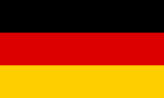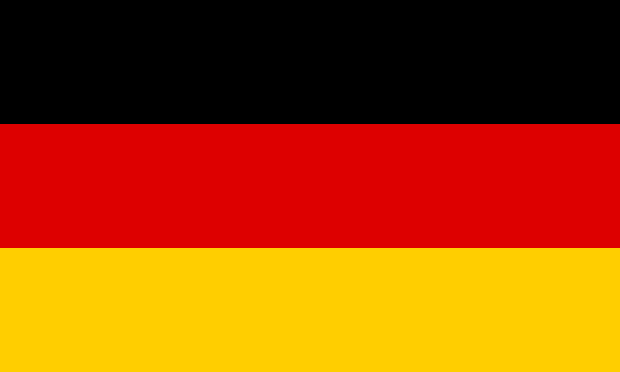
Germany

Country flag available in this resolutions
| Icon 32x19 | ![]() |
| Icon x | ![]() |
Germany
Germany, officially the Federal Republic of Germany, is a pivotal nation at the heart of Europe. Renowned for its profound historical impact, robust economic prowess, and rich cultural heritage, its trajectory from ancient Germanic tribes to a modern global leader has shaped both the European continent and the broader international landscape. Geographically diverse, it stretches from the low-lying North German Plain, through the Central German Uplands, to the majestic Bavarian Alps in the south. Bordering nine countries, its central European location is a crucial crossroads for trade and cultural exchange, with major rivers like the Rhine, Elbe, and Danube serving as vital arteries. The climate is predominantly temperate, with distinct seasonal variations across its varied topography.
Germany’s complex history originates with Germanic tribes and the Holy Roman Empire (962 AD to 1806), a loose confederation. The 16th-century Reformation, led by Martin Luther, profoundly reshaped its religious and political landscape. Unification under Otto von Bismarck in 1871 formed the German Empire, contributing to tensions that led to World War I. The subsequent turbulent Weimar Republic’s instability paved the way for Nazism and Adolf Hitler, plunging the world into World War II and the horrors of the Holocaust. Post-1945, Germany was divided into East and West, a central Cold War battleground. The fall of the Berlin Wall in 1989 and reunification in 1990 marked a new era. Since then, the unified Federal Republic has emerged as a beacon of democracy, a leading advocate for European integration, and a responsible global actor, grappling with its past while forging a progressive future. Culturally, Germany has been a cradle of philosophy, music, and literature, deeply influencing Western thought and arts.
With over 84 million people, Germany is the EU’s most populous country, characterized by high density in urban areas like Berlin, Hamburg, Munich, and the Rhine-Ruhr. Demographic shifts, including a low birth rate and aging population, challenge its social welfare and labor market. As a major immigration destination, the country has developed a highly diverse society, with substantial communities from Turkish, Polish, and Syrian backgrounds, enriching its multicultural fabric while presenting ongoing integration dynamics. This population underpins Europe’s largest economy and the world’s fourth-largest by nominal GDP, driven by a highly skilled workforce, robust industrial base, and strong export orientation. Its strength lies in specialized „Mittelstand“ (SMEs) and multinational corporations. Key industries include automotive, mechanical engineering, chemicals, and electrical engineering. Renowned for precision engineering, quality, and innovation, Germany is a leading exporter, particularly in advanced manufacturing and green technologies. Challenges include demographic shifts, the „Energiewende“ (energy transition), and adapting to digitalization, all while upholding fiscal discipline and social market economy principles.
In essence, Germany represents a fascinating paradox: deeply rooted in its complex history, yet relentlessly forward-looking; an industrial powerhouse committed to environmental sustainability; a country of profound cultural traditions, yet embracing diversity. Its journey from fragmentation to a unified, democratic, and economically dominant force is a testament to its resilience and adaptability. As it navigates future challenges, Germany’s role as a stable, innovative, and influential global player remains undisputed, continuously shaping the contours of the 21st century.
Information about country Germany
Automated text translation, excuse errors, please!
Informations are from the publication CIA The World Factbook.
Country Germany is situated in a location / continent Europe. Germany has an area of 357 022 km2 and 81 305 856 residents. The highest point has a height 2 963 above sea level. and it is called Zugspitze. The lowest point is located at the level of -3,54 above sea level and it is named Neuendorf bei Wilster. System of government is Federal Republic and the date of independence 18th January 1871. The capital city is Berlin. Germany has the international abbreviation GM.
Germany - economy
Total gross domestic product (GDP) is 3 139 000 000 000 $. Total gross domestic product per capita in purchasing power parity is 38 400 $. GDP grows by 3.10 % a year. Inflation (consumer price index) is equal to 2.30 % a year. Germany have 43 620 000 working-age population (from a total population 81 305 856 people). Unemployment is at 6.00 %. Germany issued 8.10 % GDP to healt care and 1,50 % GDP to army. The public debt of the country is 81.80 % GDP. The total amount of foreign debt is 5 624 000 000 000 USD.
Germany - transport and telecommunications
Germany has 644 480 km of roads, 41 981 km of railway lines and 541 airports. The total length of waterways (navigable rivers, canals, etc.) is 7 467 km. There is registered 427 ships.
Number of active mobile phones (sim card) in the country Germany is 108 700 000. Number of active fixed telephone lines is 51 800 000. Germany has 65 125 000 internet users, who have the available 20 416 000 Internet connections. Germany has been assigned a domain first Choose range .de.
Germany - demography
As suggested above, Germany has 81 305 856 people. Population growth is in the amount -0.20 % per year. Number of children born per 1000 population per year is 8.33.Every mother has average 1.41 children. The infant mortality rate is 3.51 and maternal mortality 7.00 deaths per 100,000 births. Average estimated life expectancy makes 80.19 years. Mortality is 11.04 people per 1000 population per year.
Germany - energetics
Germany consumes a year 509 500 000 000 kWh of electricity. Annual electricity production is 576 800 000 000 kWh in power plants with a total installed electrical capacity 146 900 000 kW. Germany exports 57 920 000 000 kWh and imports 42 960 000 000 kWh of electricity per year Energy mix of power generation is as follows: fossil fuels: 50.5 %, nuclear energy: 13.9 %, renewable: 28.3 %, hydropower: 2.7 %. The country Germany is harvested annually 100 300 barrels of oil.
Flags of the world countries
World flags
World countries flags
Dále doporučujeme:
Odkazy na užitečné webové stránkyTipy na zajímavé weby
Naše tipy na užitečné weby
Zajímavé internetové odkazy
Odkazy na zajímavé weby
![]() |
![]() |
![]() |
![]() |
![]() |
![]() |
![]() |
![]() |
![]() |
![]() |
![]() |
![]() |
![]() |
![]() |
![]() |
![]() |
![]() |
![]() |
![]() |